The German Secret to Perfect Indoor Air: A Guide to Stoßlüften
Why opening your windows wide for 5 minutes is scientifically better than leaving them tilted all day—and how modern software takes the guesswork out of it.

If you have ever lived in Germany, you have likely encountered the cultural phenomenon of Stoßlüften. Translated literally as "shock ventilation" or "burst ventilation," it is a highly effective, rigidly followed daily practice for maintaining perfect indoor air quality.
The Science of the Burst
The concept is simple: instead of leaving a window tilted open for hours—which cools down your walls and wastes heating energy—you open multiple windows completely wide for just 3 to 10 minutes to create a cross-draft.
This rapid exchange replaces warm, stale, moisture-heavy indoor air with fresh outdoor air. Because air holds very little heat mass compared to solid walls and furniture, your heating system only has to reheat the new air, not the actual structure of your home. The result? You prevent mold, banish CO2, and save on your energy bills.
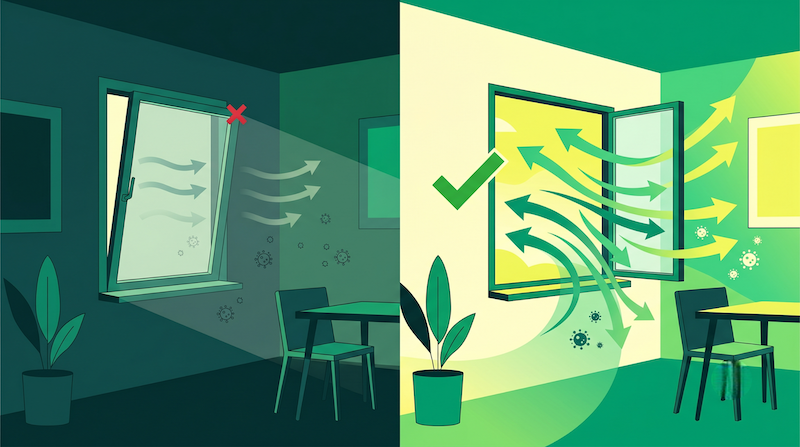
Tilted vs. Burst Ventilation
The Hidden Problem: When to Open the Window?
While Stoßlüften sounds foolproof, it has a fatal flaw in the modern world: humidity physics.
Our daily activities—breathing, cooking, showering, and drying clothes—release liters of water into our indoor air every day. The primary goal of ventilation is to remove this moisture to prevent structural mold. However, if it’s raining outside or if it's a humid summer day, opening the window might actually let more moisture into your home.
Most people rely on cheap digital hygrometers that display Relative Humidity (%). But relative humidity is completely dependent on temperature. 60% humidity at 5°C outside contains drastically less actual water than 60% humidity at 22°C inside. If you only look at percentages, you are flying blind.
The Golden Rule of Ventilation
You should only ventilate when the Absolute Humidity (the actual grams of water per cubic meter of air) outside is lower than the Absolute Humidity inside.
The Solution: Smart Utility Engineering
Calculating Absolute Humidity in your head using temperature and relative percentages requires complex thermodynamic equations. We realized this was a perfect problem for native iOS engineering to solve.
That is why we built Humidity Window - Stoßlüften.
The app acts as your intelligent ventilation assistant. It takes your indoor hygrometer readings and compares them in real-time with highly localized outdoor weather data via Apple's WeatherKit. It does the thermodynamic math instantly, telling you exactly when an open window will dry your home out, and when it will make things worse.

Stop Guessing. Start Stoßlüften.
Download Humidity Window today. Get smart alerts, optimize your indoor air quality, and protect your home from mold.