Relative vs. Absolute Humidity: Why Your Hygrometer is Lying to You
You bought a digital thermometer to track your indoor climate. It says 65%. You open the window to dry the room, but things seem to get worse. Here is the physics behind why 60% outside isn't the same as 60% inside.
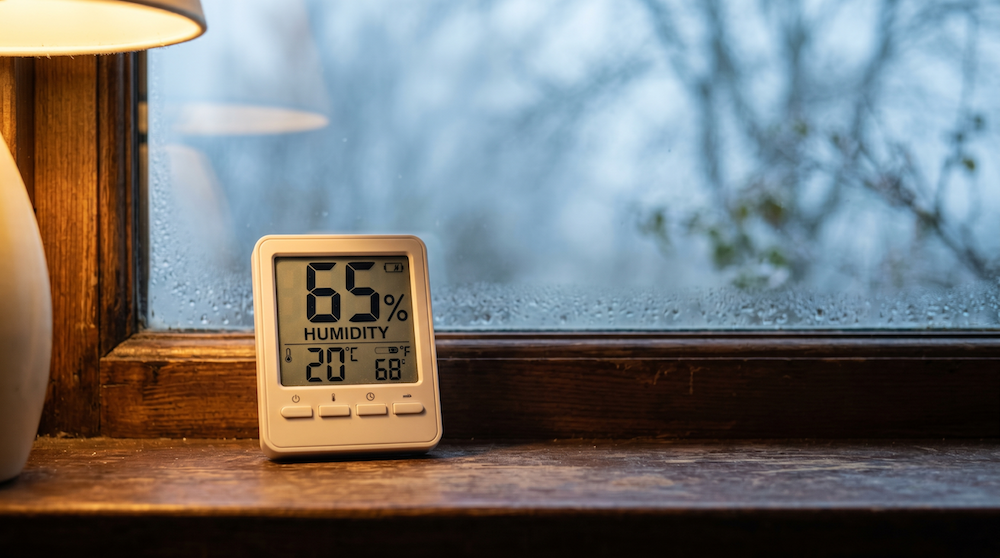
If you care about preventing mold, breathing clean air, or getting a good night's sleep, you have probably invested in a cheap digital hygrometer for your bedroom. It sits on your nightstand, displaying a percentage say, 65%. Seeing it flash high, you open the window on a cold, damp winter morning to "air the place out."
But did you actually dry your room, or did you just let more water in? If you are only looking at Relative Humidity (%), you are flying completely blind.
The Sponge Analogy: Understanding Relative Humidity
The percentage displayed on consumer weather stations is Relative Humidity (RH). This number does not tell you how much water is in the air. Instead, it tells you how full the air is relative to its maximum capacity at that specific temperature.
Think of the air like a sponge. Warm air is a massive bath sponge. Cold air is a tiny kitchen sponge.
- If the tiny kitchen sponge (cold air) is 80% full of water, it only holds a few drops.
- If the massive bath sponge (warm air) is 50% full, it holds an entire cup of water.
Even though 80% is a higher percentage than 50%, the 50% sponge contains vastly more actual water. This is exactly how temperature affects air.
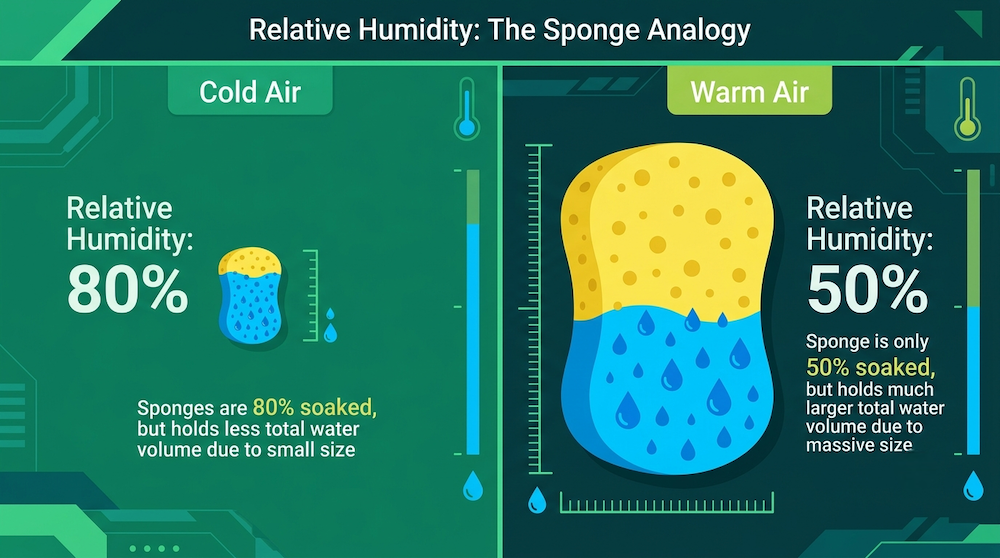
Temperature dictates capacity
Absolute Humidity: The Truth of the Matter
To truly understand your indoor air, you need to know the Absolute Humidity. This is the actual, physical weight of water vapor in the air, usually measured in grams per cubic meter (g/m³). It ignores temperature and gives you the raw facts.
Let's look at a real-world winter scenario:
Temperature: 5°C
Relative Humidity: 80%
Absolute Humidity: ~5.4 g/m³
Temperature: 21°C
Relative Humidity: 60%
Absolute Humidity: ~11.0 g/m³
Look closely at the numbers. The outside air reads a terrifying 80% humidity. Your inside air reads a comfortable 60%. But the air inside your bedroom contains twice as much actual water (11.0 g/m³ vs 5.4 g/m³).
If you open the window in this scenario, the cold outdoor air will rush in, warm up to 21°C, and its relative humidity will plummet. You will effectively dry out your room, even though it's "more humid" outside!
The Calculation Problem
Herein lies the problem: calculating Absolute Humidity requires complex thermodynamic equations involving saturation vapor pressure and the Clausius-Clapeyron relation. You can't do it in your head, and standard hygrometers won't do it for you.
We realized this was a massive pain point for anyone trying to maintain a healthy home, practice proper Stoßlüften (burst ventilation), or prevent winter mold.
So, we engineered the solution.
Meet Humidity Window.
Our native iOS app pulls highly localized weather data via Apple's WeatherKit, calculates the indoor and outdoor absolute humidity differentials in real-time, and tells you exactly when opening the window will actually dry your home.